Google Pixel Tag goes on sale in eight countries for $29.99
Google's Pixel Tag tracker costs $29.99 and went on sale in eight countries, including the US, on November 11. No EU country made the list.
On November 11 Google began selling Pixel Tag, its first tracker for finding keys, wallets and luggage, which it announced in August alongside the Pixel 11. The tracker is sold in only eight countries, including the US, and none of them is a member of the European Union. That is a little odd, because in July, before the official announcement, Pixel Tag showed up in German online stores.
Where and for how much
Pixel Tag is sold through the Google Store and Amazon. One tracker costs $29.99 and a four-pack $99.99. There are eight countries on the list: the US (excluding Puerto Rico), Canada, the UK, Australia, India, Japan, Singapore and Taiwan. By comparison, the Pixel 11 phones and the Pixel Watch 5 are sold in about two dozen countries.
Google has not explained why, and the list may grow. 9to5Google expects the tracker will probably work outside these countries too, since travel is one of the main reasons to buy one, but this has not been confirmed. Anyone buying it from a reseller or abroad will struggle to claim on the warranty.
What it offers
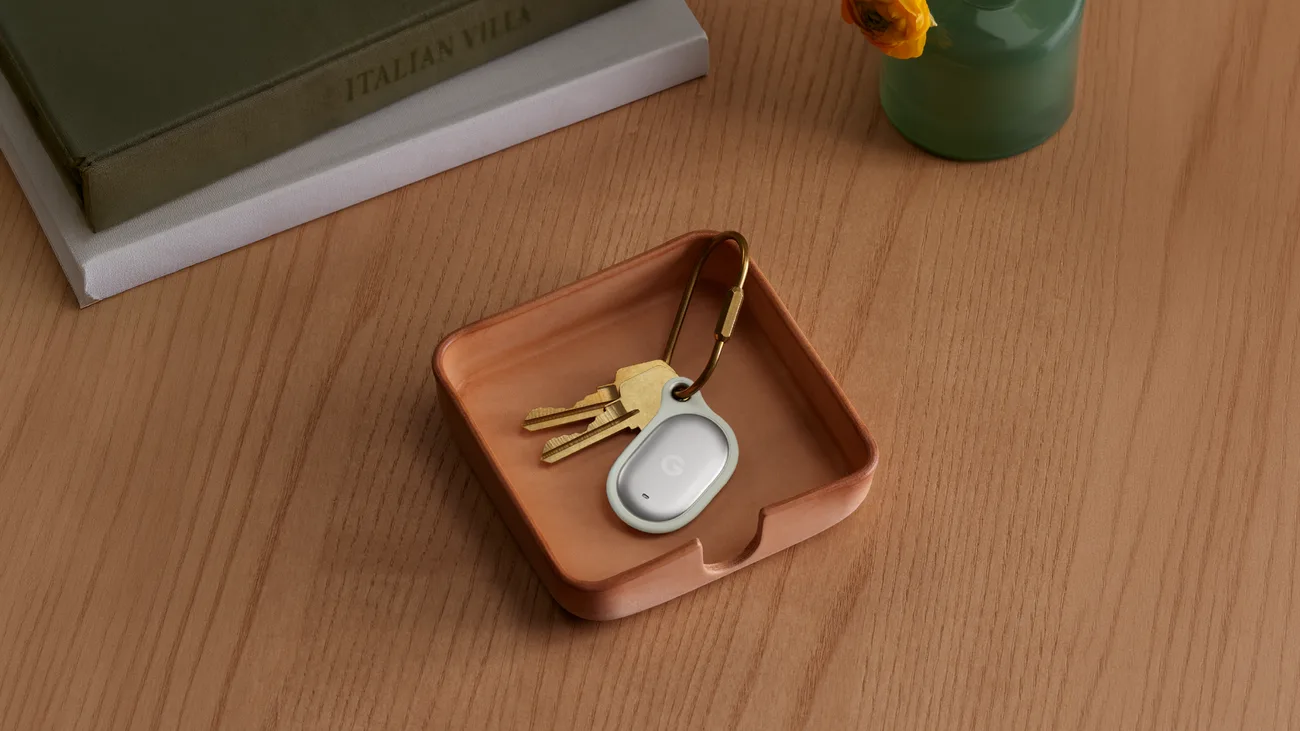
Pixel Tag is pill-shaped, with a stainless steel front bearing the G logo and a speaker cut-out, and a polycarbonate back in a light green shade called Fog. The key details:
- Connectivity: Bluetooth 6.0 with Channel Sounding, ultra-wideband (UWB) radio and NFC. It is the first Find Hub tracker with NFC: tap it with your phone and its settings open.
- Precision finding: UWB shows where the item is with an arrow and a distance, if your phone has UWB.
- Battery: a replaceable CR2032 coin cell that should last around a year.
- Protection: IP67 against water and dust.
- Button: a double press rings your phone if it is nearby.
- Compatibility: phones running Android 9 or later, and a tag can be shared with up to ten people.
For long-range finding it uses the Find Hub network of more than a billion Android devices. When a lost tag passes someone else's phone, that phone reports its location in encrypted form. There are also left-behind alerts, with exceptions for home or work.
You will need to buy a case separately
Pixel Tag has no key ring hole, so you can only attach it to keys or a bag with a case. Google does not make its own, but its store sells partner cases: the Bellroy Lite Case Duo (two-pack) for $24.99, a Bellroy leather case for $29.99, and the Spigen Vault for $19.99 and Core Armor for $24.99.
How it performs
Ben Schoon of 9to5Google tested it for a week and called it the gold standard among Find Hub trackers. He praised the fast pairing, loud speaker and reliable UWB finding on a Pixel 11 Pro XL. Directional cues disappeared at around three meters. The biggest weakness is not the tracker but the Find Hub network, which he says remains "hit or miss".
Our subjective take
Google has built a good tracker and then kept it from a big part of its audience. Europe is one of the few regions where Android holds a majority and where the Find Hub network would be densest, yet it has been left out.
If you live in one of the eight launch countries and have a Pixel 11 Pro or another Android phone with UWB, Pixel Tag is an excellent choice for $30, plus a case. Everywhere else, we recommend patience or one of the Find Hub trackers already on sale locally. Importing means customs duty and an uncertain warranty, which quickly eat up any savings.
This is the subjective view of The Pocket Brief editors.
Was this helpful?
Be the first to recommend this.
Keep reading

Xiaomi Clip goes global: clip-on earbuds, Find My for the case and 38 hours of battery
Xiaomi's first open clip-on earbuds have reached its global site six months after China: 5.5 g, LHDC 5.0 and Find My for the case. No price yet.

Elecom DE-C102: a semi-solid power bank promising 2,000 cycles, but only in Japan
Elecom's 10,000 mAh power bank has a gel electrolyte, 2,000 cycles and works down to −15 °C. It goes on sale in mid-November, but only in Japan.

Power banks on planes: what applies in 2026 and why you can no longer charge them in flight
Since March 2026 you may carry at most two power banks and must not recharge them on board. How to work out Wh and what Lufthansa, Wizz Air and Emirates require.